
FLEX connects to the systems your grid already runs on, builds a digital twin of your network, and turns it into ranked, explainable recommendations for planning and operations. It does not replace your GIS, SCADA or planning tools — it works on top of them.
FLEX reads from and writes to the systems your grid already runs on — and works alongside modern grid platforms including envelio and Plexigrid. No rip-and-replace, no parallel data model.
Network topology, asset geometry and connectivity — the base layer FLEX builds the digital twin from, read directly from your GIS.
Planning-grade network models and load-flow cases, imported and exported without manual re-modelling — so planning and operations work on one model.
Real-time measurements, switch states and alarms from the control room — the live signal behind state estimation and congestion management.
Smart-meter readings and load profiles that fill the gaps between sensors — turning metering data into an operational signal instead of a billing archive.
Operational state in, ranked switching and remedial actions back out — delivered into the workflow your operators already use, not a second screen.
Asset master data, ratings and work orders — so every recommendation references the assets and maintenance state you actually plan with.
Your grid model stays yours. FLEX is built on open interchange formats — CIM/CGMES, pandapower, OpenDSS, PSS/E and GeoJSON — so everything we compute is portable, auditable and reusable in the tools you already trust.
Flexible connections with limits that adapt to the actual grid state — the mechanism behind flexible network access.
Compute and publish available capacity per location — continuously, not once a year in a PDF.
Orchestrate batteries, power-to-heat and other controllable assets to keep the grid inside its limits — and minimise what actually gets curtailed.
Automatically generate, test and maintain the remedial action lists your operators reach for when the grid is under stress.
A reliable real-time picture of the MV grid from the measurements you already have. The foundation everything else stands on.
Non-costly switching actions that relieve overloaded lines before redispatch, curtailment or reinforcement.
Four screens from FLEX: the day-ahead plan, the detailed day view with and without control, and the operator live view in which every option is priced against the same criteria.
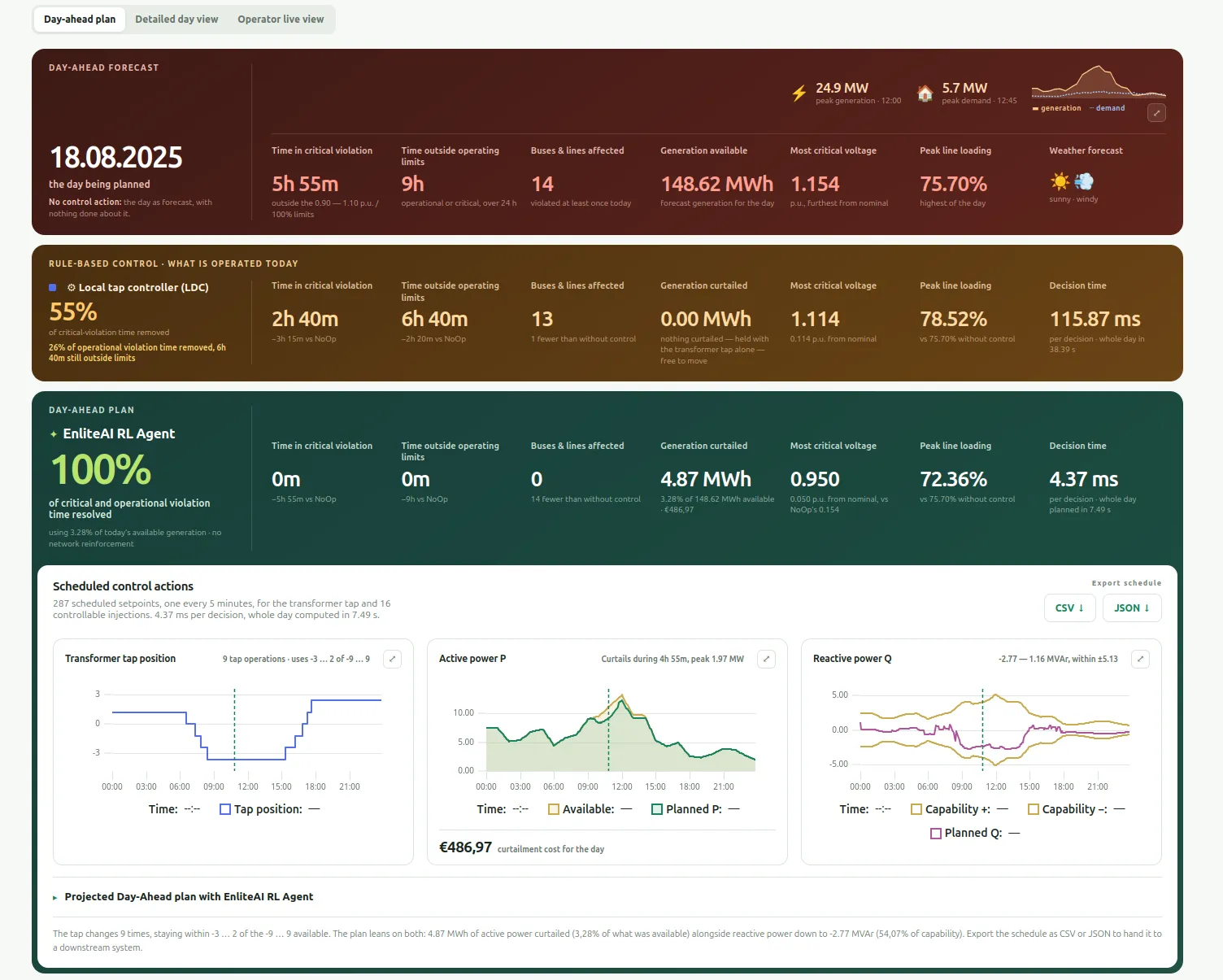
The forecast day, today’s rule-based control and the RL agent’s plan side by side — violation time, curtailment, decision time — with the scheduled setpoints for tap, active and reactive power, exportable as CSV or JSON.
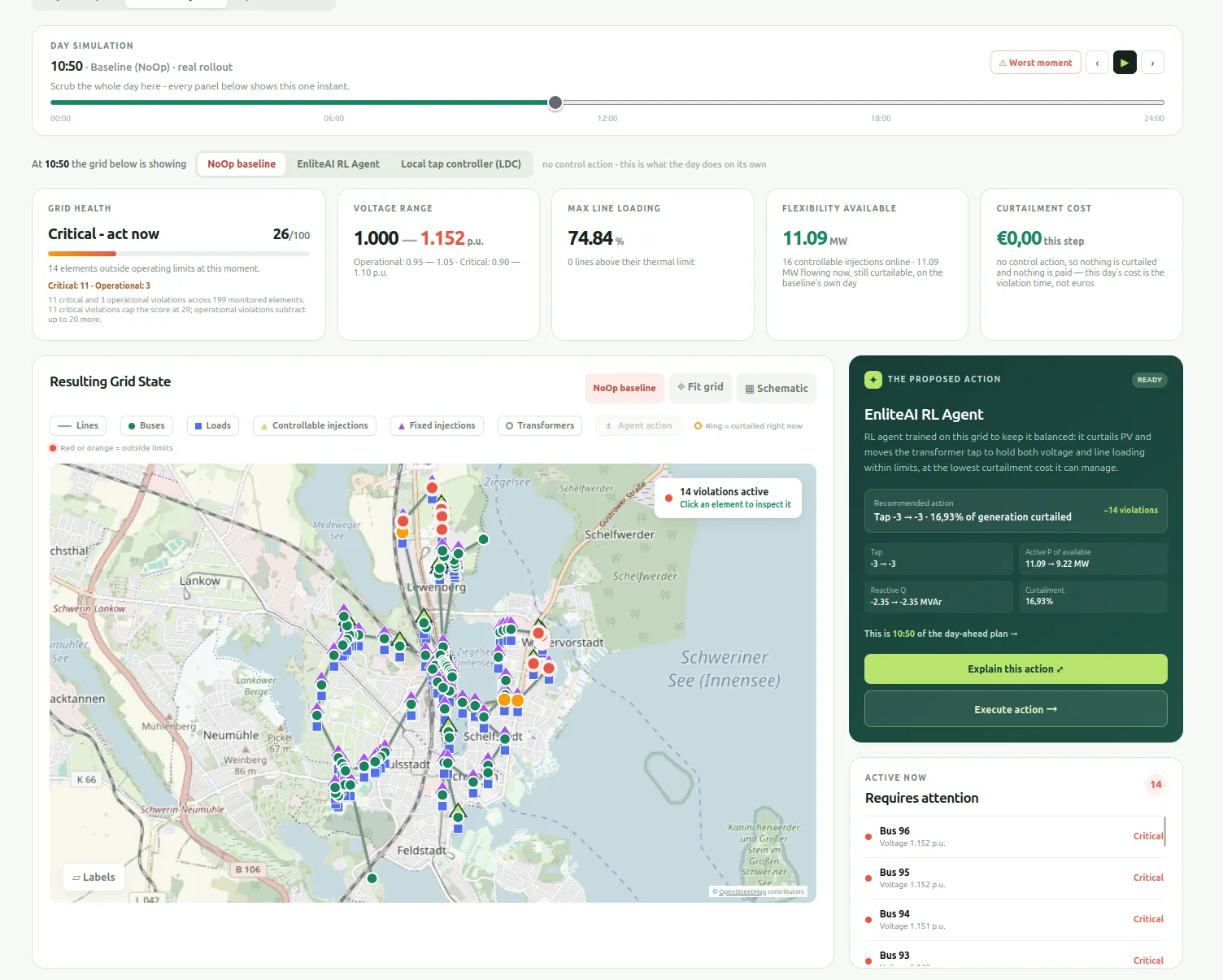
Scrub through the day; every panel shows one instant on the real grid map. Here the baseline at 10:50: 14 elements outside their limits, and the action the agent proposes for exactly this moment.
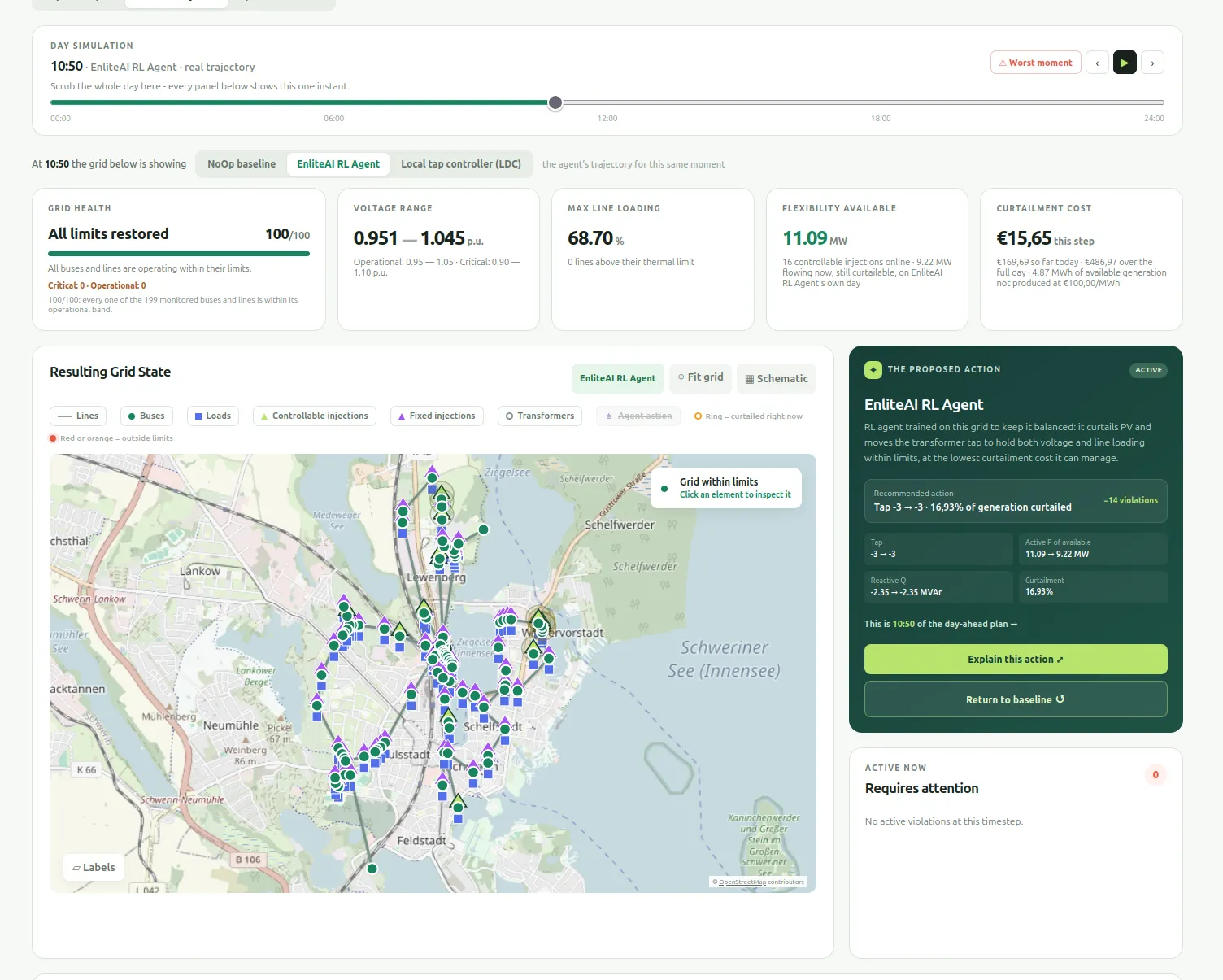
The same moment with the agent’s trajectory: all limits restored, voltage range and line loading back inside the band, and the curtailment cost of the step shown in euros.
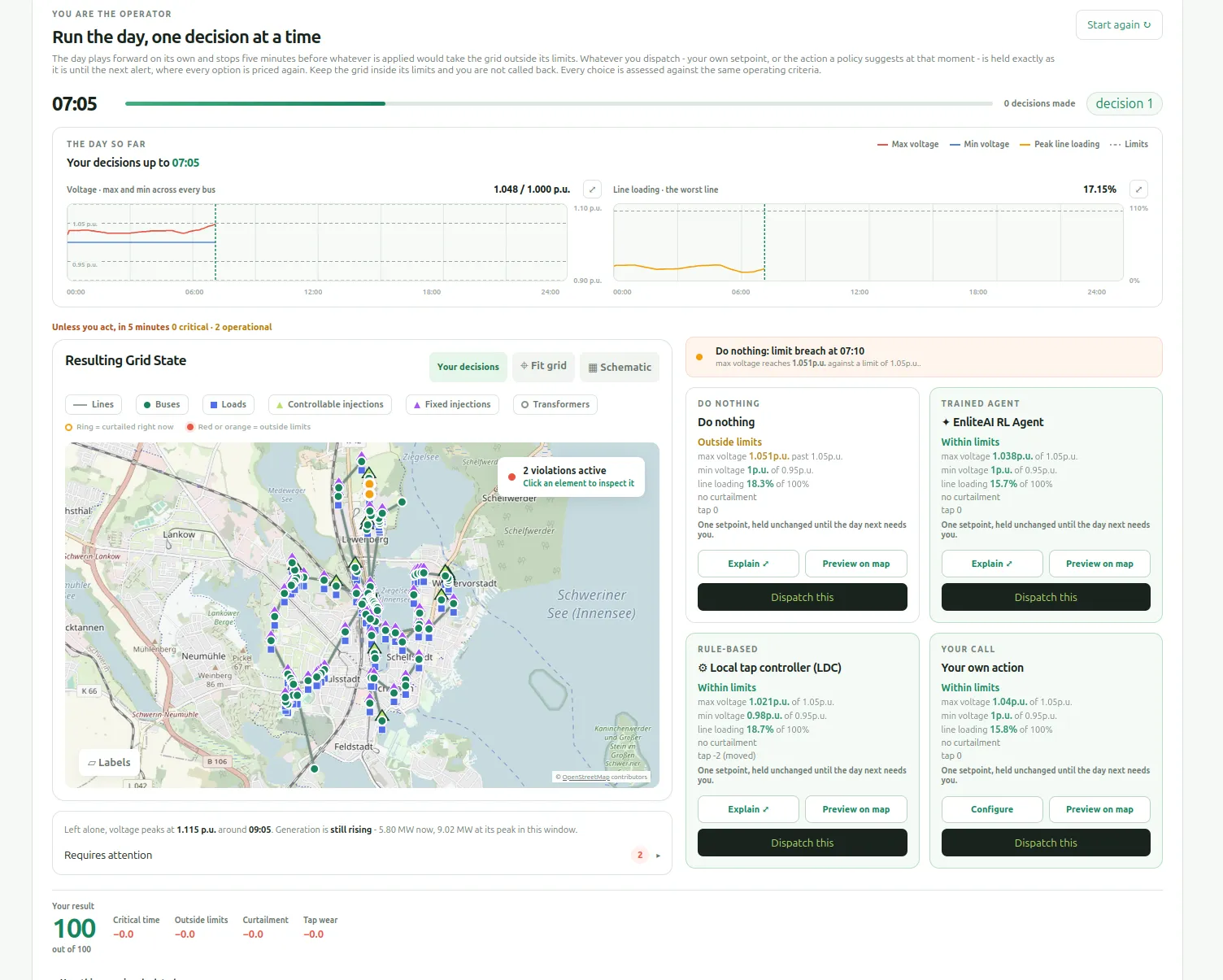
Run the day one decision at a time. At every alert the options are priced on the same criteria — do nothing, the trained agent, the rule-based controller or your own setpoint — and the operator dispatches.
FLEX is built for critical infrastructure. Every recommendation is tested against three layers of reality before it reaches the operator.
Every option is validated against a physics-based digital twin of the grid. Voltage limits, thermal constraints, power flows and N-1 security are part of the decision process — not checked afterwards.
Grid codes, operating policies and regulatory requirements are embedded as explicit constraints. FLEX recommends only actions that comply with the rules under which the operator must act.
FLEX explains, ranks and compares the available options. The operator remains in control, applies operational expertise and makes the final decision.
The same platform, wherever your security policy needs it to run.
Start on a single engineer's machine — the whole optimisation stack runs on one GPU.
EU-hosted, scaled on demand for planning studies and batch analyses.
Inside your perimeter, air-gapped if required — the default for critical infrastructure.
We run the platform and deliver the results; your teams keep the decisions.
FLEX exists because two teams that rarely sit in the same room do here: an AI research group that builds and trains reinforcement-learning agents, and power-systems engineers who model your grid with full AC physics. The agent searches; the physics decides what is allowed. Neither half works without the other.
Digital twin, the open-source Maze RL stack and parallelised Monte-Carlo tree search — the method line behind the L2RPN 2022 win and the TenneT day-ahead planner.
A full AC model of your network, your voltage and thermal limits and N-1 security enforced inside the search — validated against your planning tool, measured on real distribution grids.
Let's discuss how we can validate and implement AI solutions for your grid optimization needs — or try the live demo first.