
You cannot optimise a grid you cannot see. Distribution grids were built to be operated blind — and mostly still are: smart-meter data arrives late and gappy, sensors cover a fraction of the network, forecasts refuse to reconcile with actuals, and the picture your planning tools show is a season old. Every new duty on operators — envelopes, capacity publication, curtailment minimisation — silently assumes an observability most DSOs don't have yet.
FLEX fuses what you already measure — smart meters, secondary-substation sensors, SCADA points, feed-in data, weather — into a physically consistent estimate of the MV grid: voltages, flows and loadings across the network, every interval, with a stated uncertainty where measurements are sparse. Where there is no sensor, the estimate is a physics-based inference, labelled as such — the module tells you how confident it is, and where an additional measurement would sharpen the picture most. Plausibility checking is built in: measurements that contradict the physics are flagged and reconciled instead of silently corrupting the picture downstream.
The module also closes the loop between forecast and reality. It compares predicted against actual grid states, learns where and why they diverge, and deaggregates feeder-level forecasts down to the network locations where the deviation actually happens — the difference between "the forecast was off" and "this cable section will be the problem at 18:00."
Everything runs on open formats — CIM/CGMES, pandapower, OpenDSS — so the estimated states feed your existing planning tools as readily as they feed the other FLEX modules. It is deliberately the first module most operators deploy: it starts from the measurements you already have, produces value from data you already own, and builds the digital twin every later module reuses. Where the existing measurement base is genuinely too thin, the module's first output is a prioritised list of where sensors would pay off — not a blanket rollout.
None directly — and all of them. Flexible network access, envelope computation, hosting-capacity publication and defensible curtailment decisions each presuppose that you know the state of your grid at the relevant node. State estimation is the observability layer that European market-design rules — and national laws such as Austria's ElWG — quietly assume. It is also the honest first step for an operator whose data maturity is not yet where the more ambitious modules need it to be, which our PoC risk register names openly.
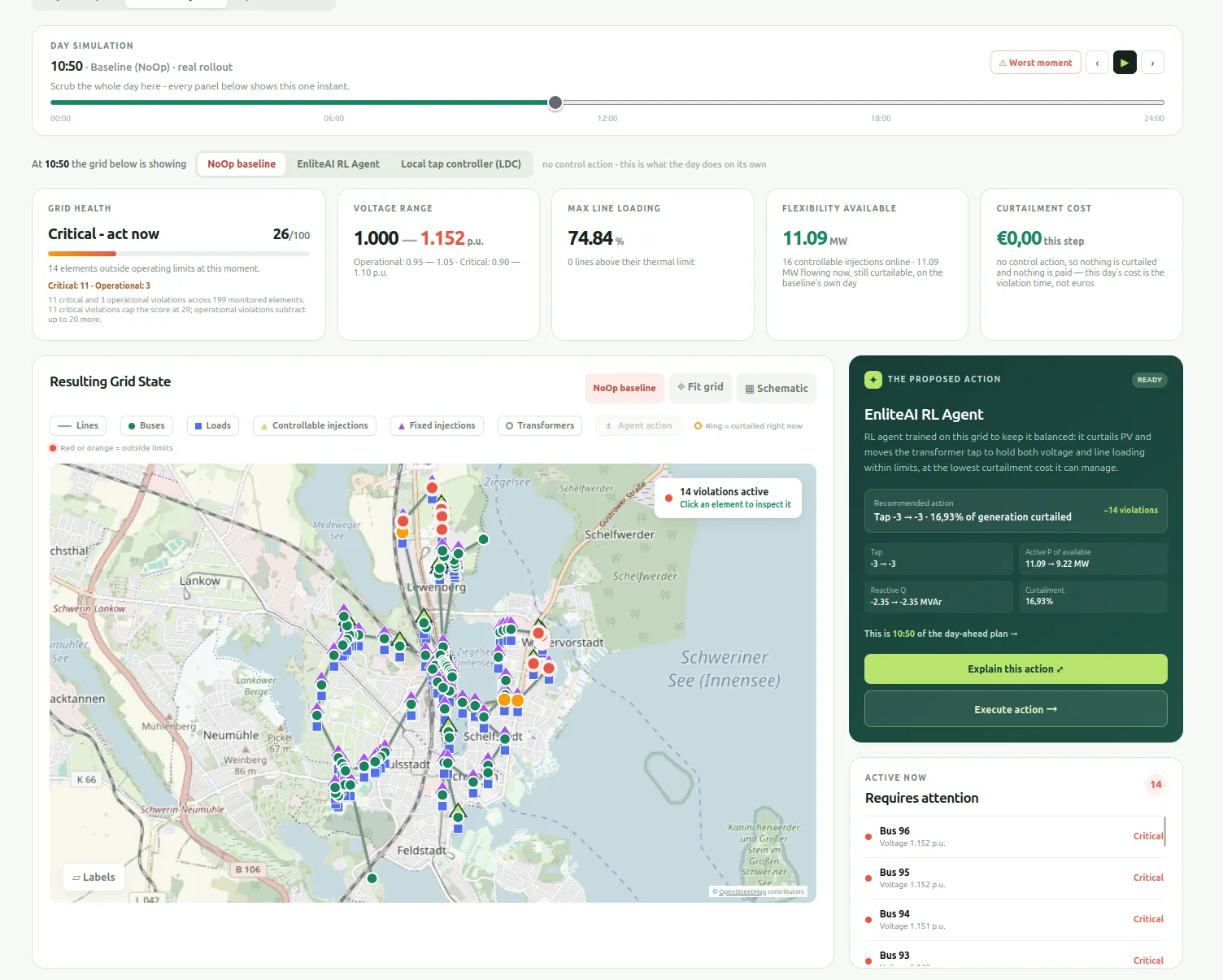
Detailed day view of the grid map — the uncontrolled baseline, with active violations shown at the network locations where they occur.
Every safety margin you carry because you cannot see the grid is capacity you are not selling.
Observability converts conservatism into capacity: every safety margin you carry because you cannot see the grid is capacity you are not selling. It also de-risks every downstream investment — sensor rollouts get targeted at the locations where estimation uncertainty is actually costly, not spread evenly by rule of thumb. And for operators weighing whether to build a data platform in-house or buy one: this module is the fastest way to find out what your data can already do before you commit either way.
A proof of concept builds the estimated state of your grid from your existing measurement data — and quantifies the accuracy gain.