
Across Europe, flexible network access is becoming the rule: connect generation and load despite constraints, with temporary limits, and deliver full access on a defined path instead of a reinforcement date years out. Static worst-case connection limits — sized for the one hour a year when everything peaks at once — are not compatible with that regime. Dynamic operating envelopes are the alternative.
A dynamic operating envelope replaces, or works in addition to, the fixed connection limit, adapting to the actual state of the grid: when the network has headroom — which is most hours of the year — the envelope opens; in the rare stressed hours it tightens. FLEX computes envelopes per connection point on the digital twin, so every envelope is guaranteed feasible under the real physics of your network, not an approximation across a feeder.
The same computation, run across all nodes instead of one, produces your hosting-capacity map: how much generation or load each part of the grid can accept, continuously updated as the grid and its use change. That map is what capacity-publication duties across Europe now ask of distribution operators — spatially granular and machine-readable, not an annually updated PDF.
Operationally, the module gives your connection process a third answer besides "yes" and "wait for reinforcement": "yes, inside this envelope, with a documented path to full access." It also tracks the clocks — which flexible connections you granted when, what full-access deadline each one carries, and whether the planned capacity path (found, or built) is on schedule.
The EU frame — Regulation 2024/1747 and Directive 2024/1711, in force since 16 July 2024, with national transposition following the Directive’s deadlines — strengthens flexible connection agreements, transparency on available grid capacity and faster answers to connection requests across the Union. Envelopes are a mechanism for the first two and a precondition for the third: without them a constrained grid has no answer but “wait”. Austria is the worked example: § 103 ElWG allows contractual static or dynamic limits under flexible network access and, for the temporary route, sets full-access deadlines of 24, 18 or 12 months from contract conclusion depending on network level — and § 99 adds a shared capacity platform across network operators.
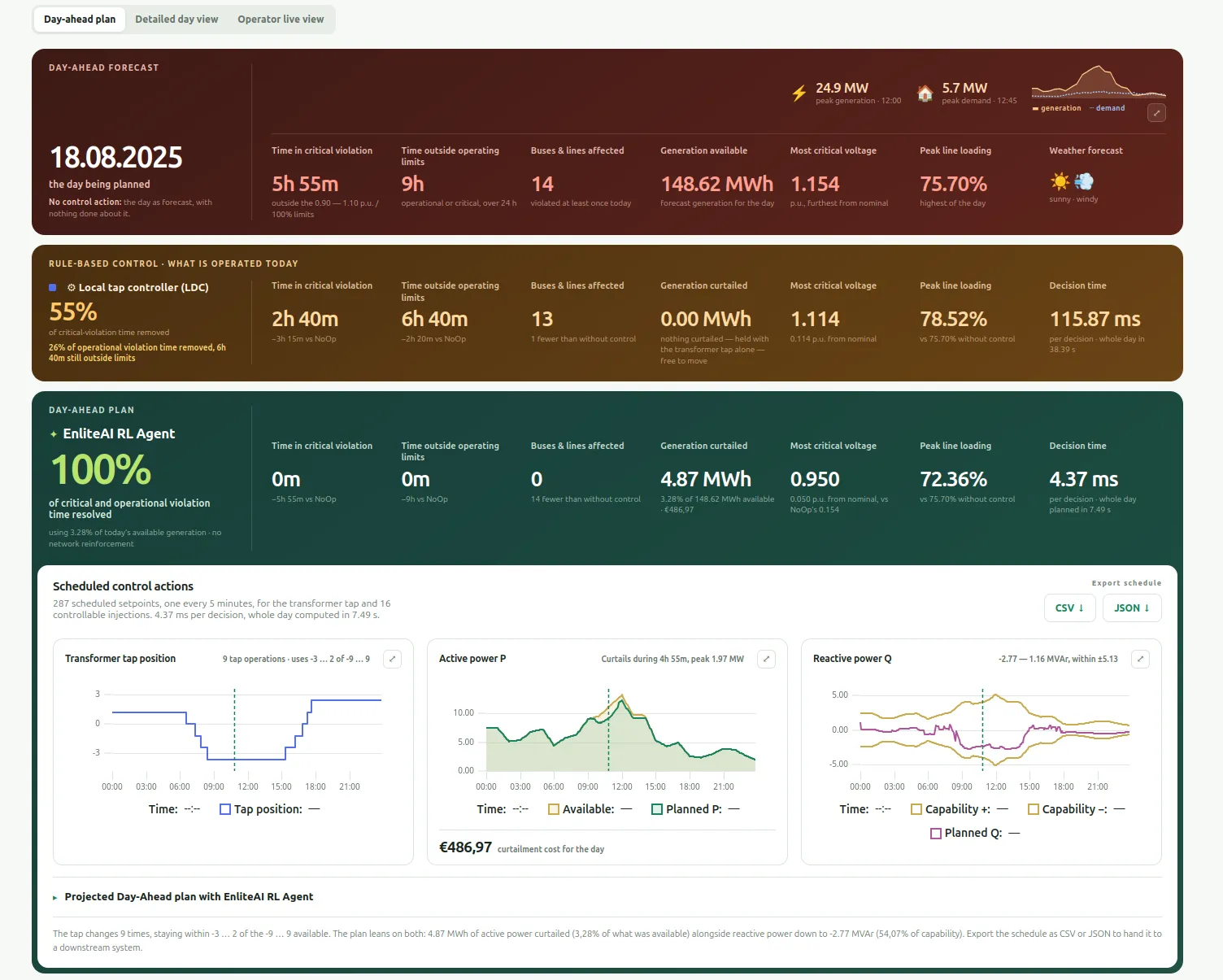
Static worst-case connection limits — sized for the one hour a year when everything peaks at once — are not compatible with that regime.
Connections are revenue — for the applicant and for you. An operator who can offer a flexible connection this quarter instead of a reinforcement date in 2031 wins the industrial customer, the charging-park operator and the housing developer. Envelopes convert your existing grid into sellable connection capacity, and the clock-tracking converts a legal risk — missed full-access deadlines — into a managed pipeline. The hosting-capacity map, published, also quietly reduces the applications you have to reject: developers stop asking where the answer is obviously no.
A proof of concept computes operating envelopes and hosting capacity on your own grid model — and quantifies the connection capacity they unlock.