
Congestion used to be a transmission problem. Rooftop PV, heat pumps and EV charging have moved it into the distribution grid — and the classic answers all cost something you don't want to spend. Redispatch costs money. Curtailment costs energy and goodwill, and regulators across Europe are tightening the rules on it. Reinforcement costs a decade. Between those options sits a lever most grids barely use: their own switchgear.
Your grid already has more than one feasible topology. Most operators run the one that was drawn when the grid was planned — not the one that fits today's load pattern. FLEX treats topology as an operational resource: it searches the space of feasible switching states — sectioning points, couplings, tie switches, down to circuit-breaker level — and surfaces the few reconfigurations that measurably lower loading on stressed lines.
The search space is astronomically large, which is exactly why it has stayed unused: no engineer, and no conventional solver, can enumerate it under AC physics in operational time. Our reinforcement-learning agents learn where in that space the good answers live. Every candidate action is then validated against the full AC power-flow physics of your digital twin, checked against N-1 security constraints, and ranked by effect. What lands with your operators is a short, explainable list: this switching sequence, this expected relief, this margin.
The module runs in two modes. In planning, it answers "which standard topology should we run this season, and where are our reserves?" In operations, it proposes curative reconfigurations when a line trends toward its limit — hours ahead, not after the alarm.
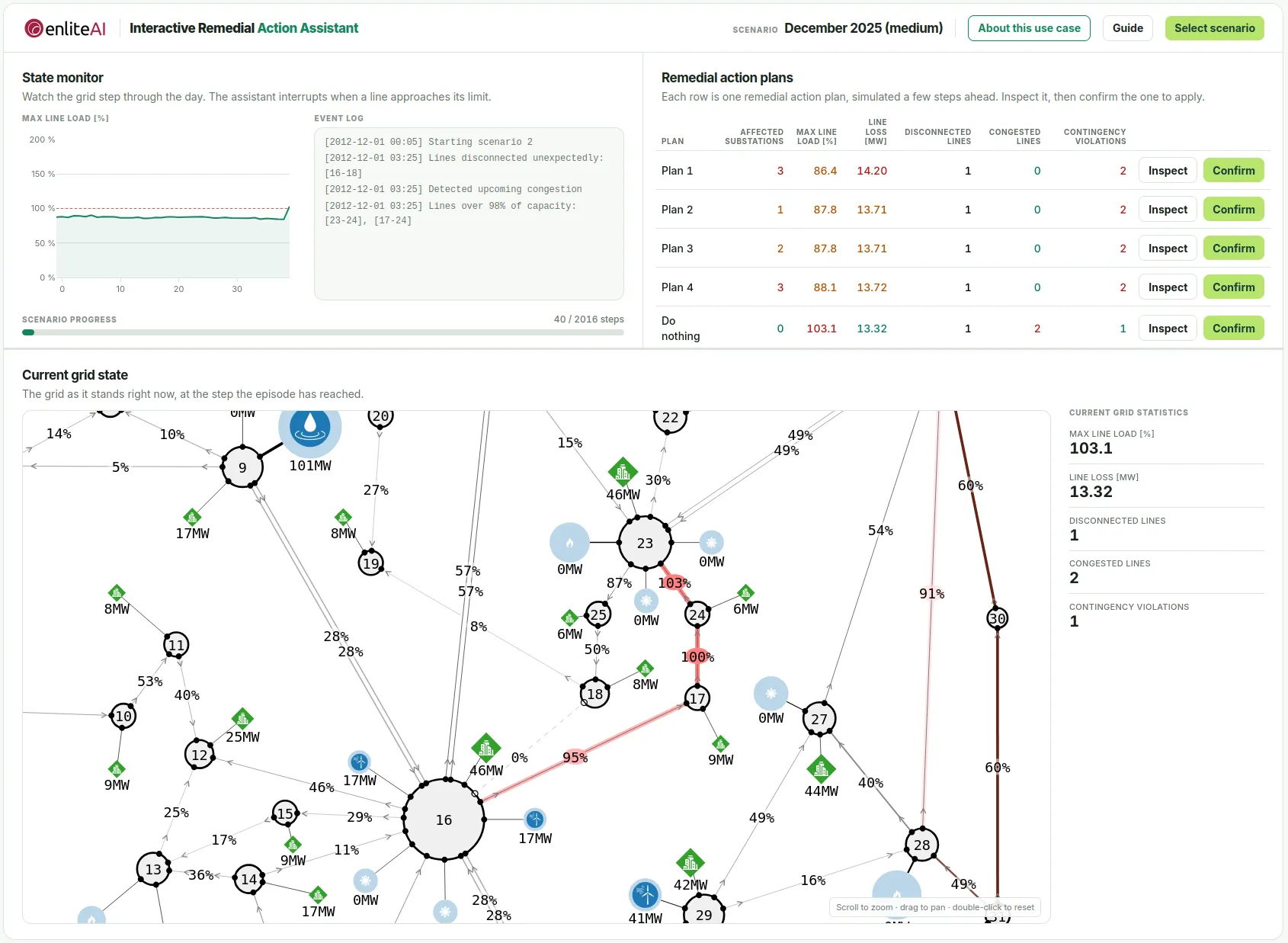
Uncontrolled baseline in the detailed day view — 14 active violations on the grid map.
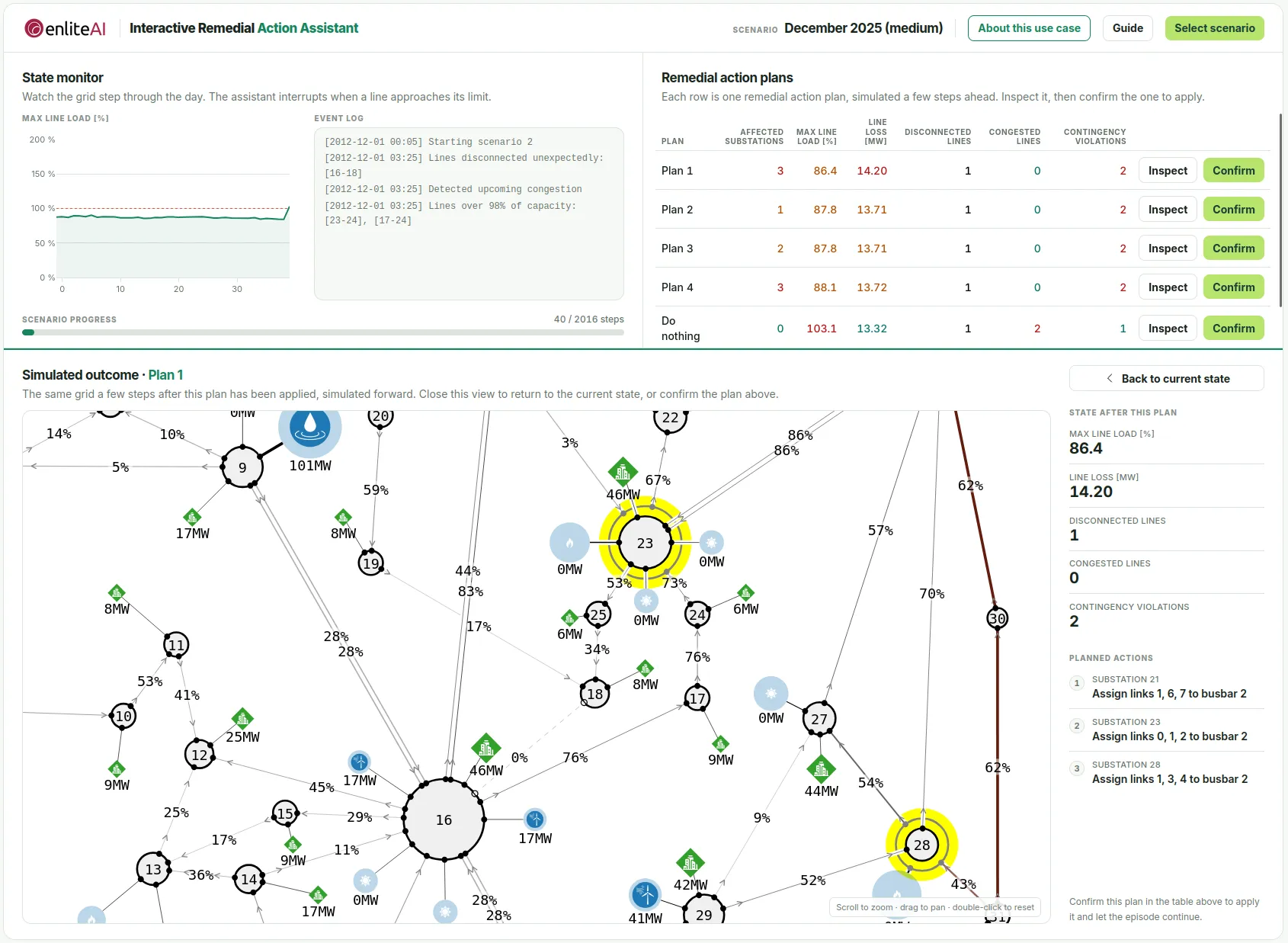
The same moment with the RL agent's plan applied — all limits restored.
Across the EU, Regulation 2024/1747 and Directive 2024/1711 point one way: use flexibility and smarter operation before reinforcement, offer flexible connections, and answer connection requests fast. Topology optimisation is how you do that without an unlimited construction budget — it finds the capacity that is already in the grid before you build more. Austria is the worked example: the ElWG (in force since December 2025) provides for flexible network access and, under its temporary route, requires full access within 12–24 months of contract conclusion depending on network level, with statutory extensions only for documented delays outside the operator’s control — and § 118(5) asks operators to optimise existing lines before building new ones.
Every percentage point of loading you recover is redispatch you don't buy, curtailment you don't compensate in goodwill, and reinforcement you can defer to where it is actually needed.
Every percentage point of loading you recover is redispatch you don't buy, curtailment you don't compensate in goodwill, and reinforcement you can defer to where it is actually needed. Recovered capacity also converts directly into connections you can say yes to — which, under flexible network access, is the difference between a queue and a pipeline. The business case is grid-specific, which is why our PoC ends in a quantified one computed on your data, not a percentage from a slide.
Let's discuss how we can validate congestion management on your grid model and measurement data — ending in a quantified business case.