
The grid is filling up with assets that can act — batteries, power-to-heat, controllable generation, EV charging — but every new flexible asset makes the operator's coordination problem harder, not easier. And regulation is raising the stakes: across Europe, operators are expected to use flexibility before they curtail or build, while curtailment itself is increasingly capped, uncompensated and scrutinised. The question stops being “may we curtail?” and becomes “how little do we actually have to?”
FLEX schedules your controllable assets — battery storage, power-to-heat, flexible generation and demand — against forecast grid states, so that constraint violations are resolved by the cheapest willing flexibility rather than by blanket curtailment. Because the schedule is computed on the digital twin, every activation is physics-checked: the module doesn't just balance energy, it respects voltage bands, thermal limits and N-1 security at the specific location of each asset.
The second half of the module is remedial action curation. Every control room keeps a mental (or Excel-shaped) library of "what we do when line X trips". FLEX generates that library systematically: it simulates contingencies across the twin, searches for effective countermeasures — switching, flexibility activation, setpoint changes — and maintains a ranked, tested remedial action list per contingency. When your grid changes, the lists update; when reality deviates from the plan, your operators reach for actions that were validated this week, not five winters ago.
Both halves compound: curated remedial actions tell the scheduler what stress the grid can absorb, and the flexibility schedule reduces how often remedial actions are needed at all.
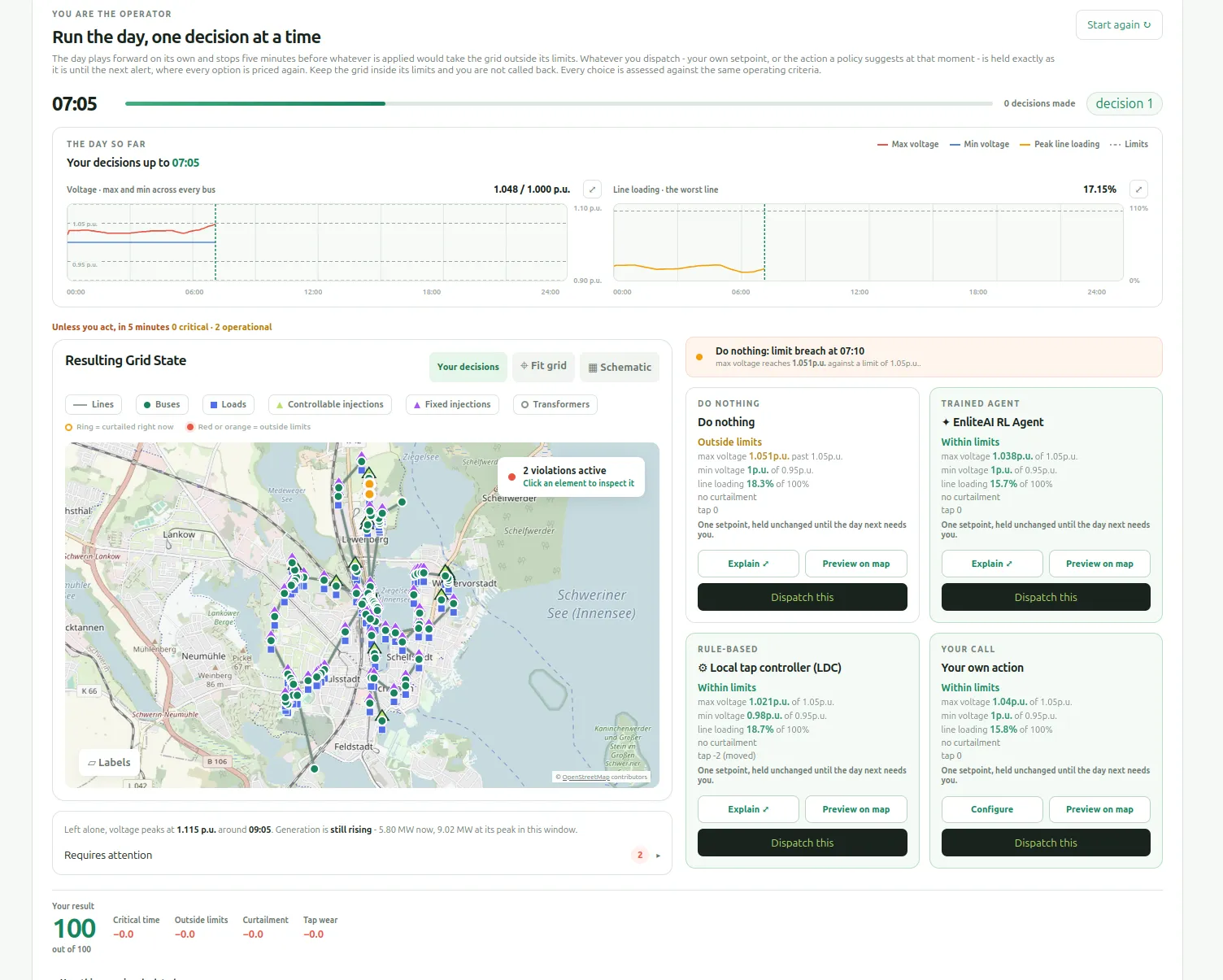
Operator live view: run the day one decision at a time and compare do-nothing, the trained agent, rule-based control and your own action — every option physics-checked on the digital twin before it reaches the grid.
Directive 2024/1711 obliges member states to enable flexible connection agreements and market-based congestion management — the same mechanics this module automates — and Regulation 2024/1747 puts flexibility ahead of reinforcement across the Union. Operators who curtail bluntly will pay in producer trust and political attention; operators who can show they minimised actual curtailment through flexibility will own the argument. Austria shows how concrete this gets: from 1 January 2027 the ElWG caps PV feed-in at 70% of module peak and wind at 1% of annual production, without compensation.
Operators who can show they minimised actual curtailment through flexibility will own the argument.
Minimised curtailment keeps producers connected, producing and on your side — and keeps you out of the regulator's case studies. Systematic remedial action curation converts senior-operator intuition into an auditable asset of the company, which matters both for AI Act documentation and for the generation of operators about to retire. And a grid that can absorb more stress with the assets it has is a grid that connects more customers per euro of CAPEX.
Let's discuss how we can validate flexible asset management on your grid and asset data — ending in a quantified business case.